From measured data to a working controller.
Data-driven methods tune a controller from input–output data collected on the process, without first building a detailed model of the plant. Our work covers the theory behind these methods, the design of experiments that produce informative data, and their application to real systems.
Virtual Reference Feedback Tuning
One-shot tuning from a single batch of data, extended to multivariable, non-minimum phase, cascade and disturbance rejection problems.
Optimal Controller Identification
Controller design cast as a prediction error identification problem, bringing the statistical tools of identification to data-driven control.
Identification & Experiment Design
Identifiability, input design and regularized estimation, from single loops to dynamic networks.
Publications
49 journal articles, 59 conference papers, 2 books and 25 PhD and master’s theses since 2006.
Our papers appear in Automatica, IEEE Transactions on Automatic Control, IEEE Transactions on Control Systems Technology, Annual Reviews in Control and the Journal of Process Control, among others. Author versions are available for download whenever the publisher allows it.


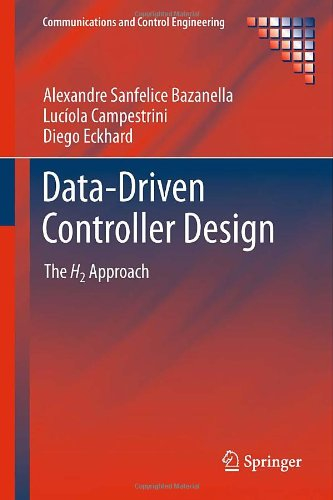
Data-driven Controller Design: The H2 Approach
A. S. Bazanella, L. Campestrini and D. Eckhard (Springer, 2012). Direct methods (VRFT) and iterative methods (IFT, DFT, CbT) are put under a common theoretical framework, with guidelines for the choice of reference model, experimental conditions and optimization method.